
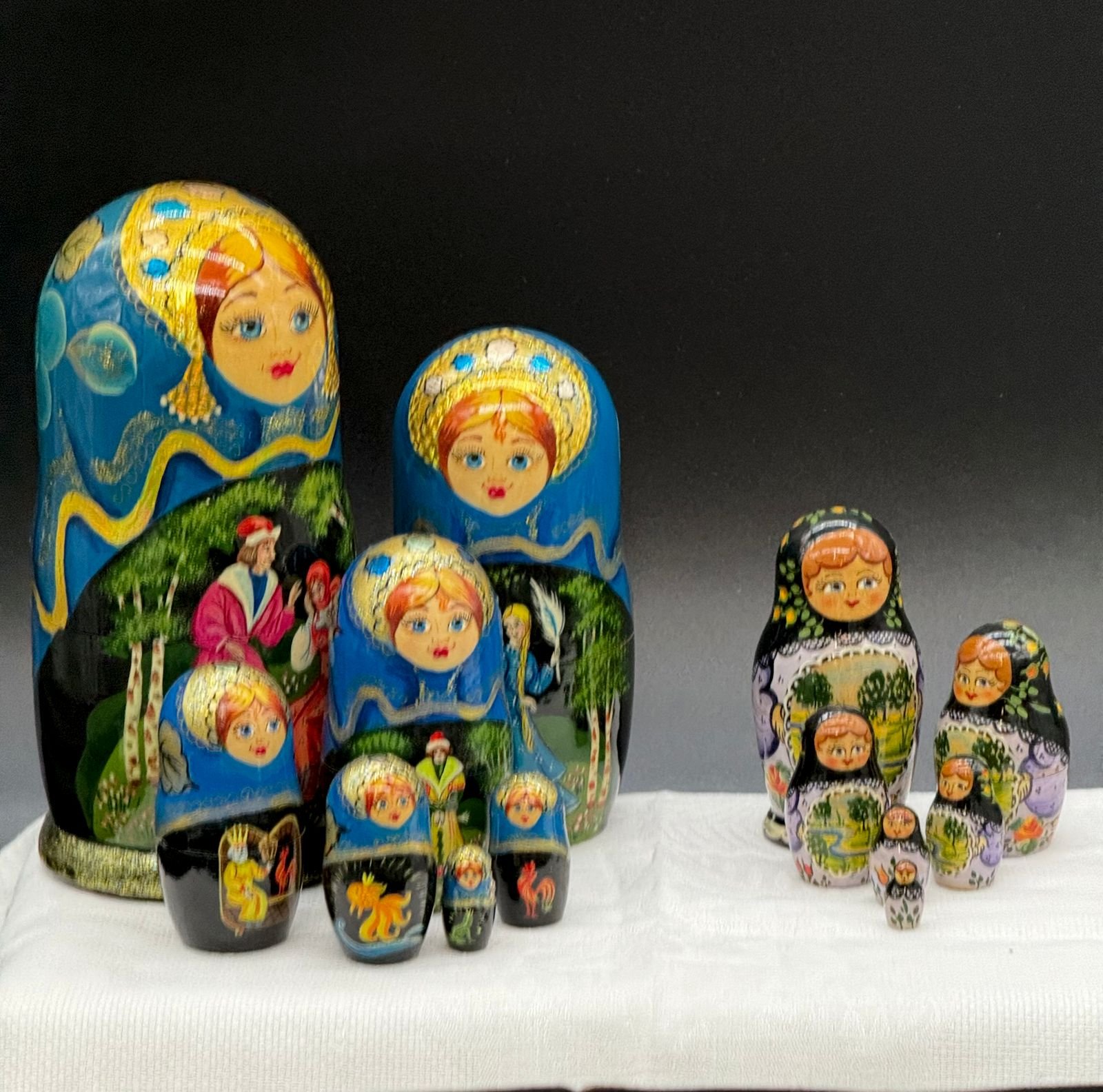
Open the tallest one and there is another inside. Open that and there is another, and it keeps going until you are holding a doll the size of a thumbnail. There are two complete sets here, thirteen dolls in all, every one painted by hand, and the smallest are so small you wonder how a brush ever got in there.
The blue set runs seven deep. Each doll wears a gold kokoshnik, the traditional Russian headdress, and the bodies open into forest scenes, white birches and figures in red and green moving between them. The black lacquer panels on the little ones are where the story turns specific: a crowned tsar, a firebird with its tail ablaze, a golden fish, a golden cockerel. Two of those came straight from Pushkin, and a Russian child would name all four on sight.
The black grounds and fine gold work borrow the language of Russian lacquer miniature painting. Whoever did these was not decorating a souvenir. The faces are individual rather than stamped, the eyes sit a little differently on each one, and the birch bark is built up stroke by stroke.
The second set, six dolls, is quieter. Black headscarves scattered with small flowers, lavender aprons, and a soft green landscape on every front, repeated faithfully at each size right down to the last one, which is smaller than a peanut and still has a face.
Nesting dolls are one of the few antiques that are also a game. Children line them up by height. Adults pop the top off the big one just to see how far down it goes. Either way somebody ends up on the floor with all thirteen in a row.
Come see them in person at Pollyanna’s Antiques in downtown Mt. Clemens, open Wednesday, Friday, and Saturday from 10 to 4. Ask and we will open them for you. It never gets old.